- Wealth Made Simple
- Posts
- Is tax deferral worth it if future tax rates go up?
Is tax deferral worth it if future tax rates go up?
You're likely already using the starter pack strategy. Here's how to graduate to the advanced tier

Marcel Miu, CFA, CFP
March 08, 2026
The Strategy You’re Already Using (Without Realizing It)
You might think tax deferral is some complex scheme reserved for hedge funds or the ultra-wealthy.
The truth is that 99% of people are already doing it.
Every time you contribute to your 401(k), you’re making a strategic bet. You’re deciding to keep money on your balance sheet to grow today rather than giving it to the IRS immediately.
But the 401(k) is just the starter pack. It has strict limits that cap out at $24,500 a year (2026 limits). For high earners, that limit is a drop in the bucket. It barely moves the needle on your long-term tax liability.
What if you could apply that same mathematical principle to 50 percent of your salary? Or what if you could apply it to $1 million of concentrated stock?
That is where we start looking at wealth acceleration.
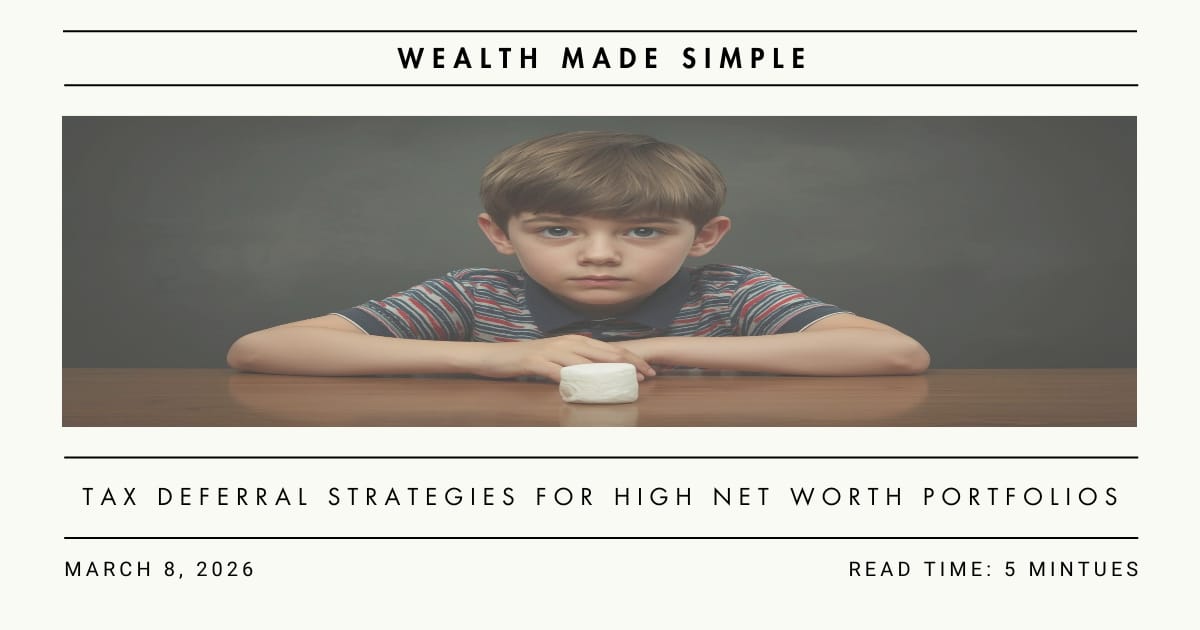
Think about the famous Stanford marshmallow experiment. Researchers offered kids one marshmallow now or two if they waited. Investing is the adult version of that test. The IRS wants a bite of your marshmallow every single year.
Advanced tax deferral is essentially telling the IRS to wait outside until you have grown your one marshmallow into a whole bag.
Why Tax Drag Can Be a Silent Killer of Wealth
A question I hear constantly is whether you should just pay taxes now if you think rates will be higher when you retire (i.e., Roth).
In many planning scenarios, the answer is no.
The mechanics of tax deferral (i.e., opting to pay taxes later) are compelling and can often help overcome even significant future tax rate hikes.
Think of tax deferral as an interest-free loan from the government. When you defer taxes, you’re essentially borrowing money from the government at 0 percent interest and investing it for yourself.
Even if you withdraw the money later at a 45 percent tax rate versus paying 37 percent today, the compound growth on that deferred tax money over 10 or 15 years can create a buffer. That buffer may help offset the difference in tax rates.
Just like your 401(k) seeks to grow faster than a brokerage account because of pre-tax compounding, strategies like Non-Qualified Deferred Compensation and Exchange Funds apply that same concept to larger sums of capital.

Beyond the 401(k): Non-Qualified Deferred Compensation (NQDC)
If the 401(k) is the sedan of retirement planning, the Non-Qualified Deferred Compensation (NQDC) plan is the Formula 1 car. It’s often referred to as a "Super 401(k)" for executives.
While your 401(k) caps out quickly, NQDC often allows you to defer up to 80 or even 100 percent of your salary, bonus, or commissions.
Here’s the potential impact on your balance sheet.
Imagine you have a $100,000 bonus coming your way.
In a taxable scenario, you take that bonus today. The IRS takes $37,000 immediately (assuming top brackets). You’re left with $63,000 to invest.
In an NQDC scenario, you defer the full $100,000. You invest $100,000.
Compounding on a $100,000 base beats compounding on a $63,000 base. Over a decade, this difference in the starting principal is designed to create a larger ending balance, even after you pay the taxes upon distribution.
If your company offers this benefit, the rules can be complex regarding distribution schedules. For a deeper dive, read my newsletter issue on Non-Qualified Deferred Compensation (NQDC) Plans.

The "401(k)" for Your Concentrated Stock
Many tech professionals and executives face a different problem. You have large sums of money tied up in company stock like Amazon, Google, or Apple. You bought it years ago, or received it as equity compensation, so your cost basis is extremely low.
You know you need to diversify. Holding a single stock involves significant concentration risk. But selling triggers a massive tax bill immediately. You could lose 30 percent or more of your principal to federal and state taxes on day one.
A potential solution is an Exchange Fund.
An Exchange Fund allows you to contribute your stock into a pool with other investors. You swap your single stock for a diversified slice of the pool without triggering an immediate tax event.
It works similarly to a 401(k) rollover, but for stock. The goal is to keep your $1 million principal working for you instead of losing $300,000 to the IRS immediately.
Exchange funds aren't the only tool for managing a heavy stock position. I previously broke down other strategies for Managing Concentrated Positions in Publicly Traded Tech Stocks.

FAQ
If NQDC is so good, why doesn't everyone do it?
It comes with credit risk. Unlike a 401(k) where the money is yours, NQDC assets are technically owned by the company until they pay you. If the company goes bankrupt, you’re an unsecured creditor. It requires a stable employer with a solid balance sheet.
Is an Exchange Fund the same as an Exchange Traded Fund (i.e., ETF)?
No. An Exchange Fund a private partnership for accredited investors or qualified purchasers. It typically requires a 7-year hold to get the full tax benefit. It’s a long-term wealth preservation tool, not a trading vehicle, and involves higher fees and liquidity constraints compared to ETFs.
Does tax loss harvesting count as deferral?
Yes. By realizing a loss today to offset a gain, you’re keeping tax dollars in your account to grow. You will pay taxes later when you sell the new position, but you have successfully deferred the bill and kept that capital compounding for you.
Your Next Steps
Here’s what you can do this week to start exploring beyond basic tax strategies.
Check your benefits handbook. Search your company portal for Deferred Compensation or DCP. Enrollment windows are strict and usually happen at the end of the year for the following tax year. You need to know if you’re eligible now so you can plan your elections before the window closes.
Identify low basis lots. Log into your brokerage account. Look for any stock lots where the cost basis is 50 percent lower than the current price. Flag these as candidates for tax deferral strategies rather than outright selling. Selling these without a plan is a voluntary reduction of your capital.
Run a "Tax Drag" audit. Pull up your Form 1099s from last year. If you paid significant taxes on dividends or capital gain distributions from mutual funds, you’re suffering from tax drag. Consider swapping those inefficient assets into tax-deferred accounts or tax-efficient ETFs to help improve after-tax returns.
Meme of the Week

Wrap-Up
You are already using tax deferral to build wealth in your 401(k).
But for high earners, that is just the warm up.
True wealth acceleration happens when you apply that same leverage to large sums of money. Whether through NQDC or Exchange Funds, the math is clear. Keeping the government's money on your balance sheet drives superior long-term growth.
Stop letting tax drag silently kill your returns.
Let's run the numbers for your specific situation. Reply to this email or book a time on my calendar to see if these advanced strategies belong in your plan.
This newsletter is for educational purposes only and should not be taken as individual advice
Simplify Wealth Planning
Fast-Tracking Work Optional For Employees Earning Company Stock | Turn Your Stock Comp Into Wealth, Cut Taxes & Live Life Your Way | Flat Fees Starting at $7,000
Marcel Miu, CFA and CFP®, is the Founder and Lead Wealth Planner at Simplify Wealth Planning. Simplify Wealth Planning is dedicated to helping employees earning company stock master their money and achieve their financial goals.
Rate Today's Edition:Your feedback helps us improve. Let us know what you think! |
Disclosures
Simplify Wealth Planning, LLC (“SWP”) is a registered investment adviser in Texas and in other jurisdictions where exempt; registration does not imply a certain level of skill or training.
If this blog refers to any client scenario, case study, projection or other illustrative figure: such examples are hypothetical and based on composite client situations. Results are for informational purposes only, are not guarantees of future outcomes, and rely on assumptions specific to the scenario (e.g., age, time horizon, tax rate, portfolio allocation). Full methodology, risks and limitations are available upon request.
Past performance is not indicative of future results. This message should not be construed as individualized investment, tax or legal advice, and all information is provided “as-is,” without warranty.
The material and discussions are for informational purposes only. These do not constitute investment advice and is not intended as an endorsement for any specific investment.
The information presented in this blog is the opinion of Simplify Wealth Planning and does not reflect the view of any other person or entity. The information provided is believed to be from reliable sources, but no liability is accepted for any inaccuracies.
We recommend consulting with your independent legal, tax, and financial advisors before making any decisions based on the information from this blog or any of the resources we provide herewithin (models, etc).